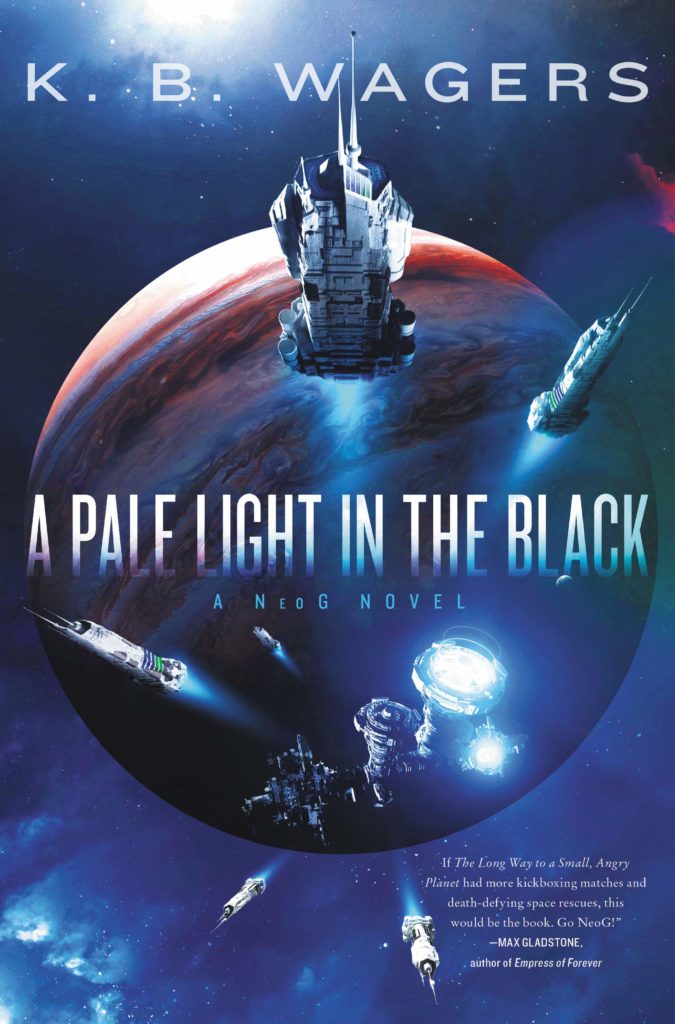
A Pale Light in the Black
It is my opportunity to write about this book. Which means it is my opportunity to be mad about it. Mad that I bought it. Mad that I read it. Mad that I bought the sequel, also in hardcover, so I could be mad about it twice.
I am going to need to be really careful here. Let me re-emphasize that this is me, dissecting what I do and do not like about the media I absorb, and not a fresh take on how I view real people. That said, this book, and anything like it on the market, infuriates me to my core, and nearly derailed my whole effort in publishing.
Recall that wild tear I took through Barns and Noble, wondering at my Midas Touch bearing not gold, but gay scifi following my extended absence from recreational reading. This was one of the spines I brushed against. And since I needed to wait for my online order of Barbary Station to arrive, I was all-in on what I had in my hands here. I had such high hopes. Coast Guard in space? I’m married to the Coast Guard, hell yeah! Sword fights? Did you read the whole “Gideon the Ninth started me on this mess”? I mean, I hardly needed anything else to spurn me onwards. Hell, half a chapter in I was already chuckling to my wife about the good setup. I think I only made it another chapter before the vibe wore off, but I guess it was a really long pandemic, so I was stuck reading the rest of it.
So this is where I get to talk about the things I have discovered to be prevalent in the current market of lesbian/queer science fiction.
This book needed to tell me everyone’s sexuality. Literally. No “learn from the story,” no context. The characters literally all have little brain chips that go “ping” and tell you if the person sitting across from you bats for your team, or any team for that matter. Which, okay, points for a progressive future. That would have been awesome to have when I was sixteen and unsure about the members of my varsity softball team. But it was obnoxious to read in literary format (you nicknamed your lesbian character “Sapphi”??). It also just drowned you in tokenism. And this started to really freak me out. I’ve read ensemble cast stories before. I’ve read bad tokenism ensemble casts before (look, I was 11 when Harry Potter and the Sorcerors Stone came out, I cannot escape that part of my past). But this threw into some stark lighting exactly how popular this sort of story is (just wait, Becky Chambers, I’ll get to you). You need to have one of everyone, and they all need to be such good friends. There needs to be someone who is gay, lesbian, trans, nonbinary, pansexual, bisexual, polyamorous, asexual, aero-ace, straight, etc. I didn’t keep a running tally but this book won the bingo game.
I mean, there’s nothing wrong with wanting that queer-norm escapism in the literature you read, but my issue was that it seemed like my work needed to also be this in order to gain any traction. Beta readers, online reviews, writing groups I tried joining… they all seemed to think this was the pinnacle direction queer sci-fi needed to go in. I still encounter it, and it’s tough. It’s definitely a personal taste thing, but it is also a market driver which is worrying to me. I don’t fare well with capitalism. I dislike the idea that what the masses want is all the rest of us get stuck with too. I know it’s how the world wants to work, but I just don’t want to read stories where the author has half-ass crammed in some representative from each corner of the queer united nations for a five second cameo.
Look, a heavily diverse cast is fine but sometimes it really feels like overly diversified casts for the sake of diversification just short changes the rest of the story. I would rather read a really good story of about three or four characters that are a small subset of a larger subculture, than grapple with fifteen characters each with some small little “I’m this flavor” identifier. Then I can read three or four other books and get an even broader exposure to different types of people. The all-in-one really wore thin on my patience.
And, as far as the queerness of the characters, well, now I need to get personal about it. None of them got to spend nearly enough time on page for their sexuality to matter any more than just needing to make a point about it. And, despite all these token queer identities, two out of maybe three of the main character story lines wound up in heteronormative appearing relationships. There were so many references to Big Men hugging small women that I was a bit concerned about what, exactly, I was reading at times. Okay, points for the lesbian relationship being the old, stable, married couple. Also, I was beyond bored by that.
Which brings up another detail that has concerned me as I started really digging into more and more queer themed media. There’s this prevailing opinion out there that these relationships have to be just absolutely pristine. No toxicity, no negativity, everyone communicates, everyone goes to therapy, no one is controlling, no narrative is furthered, everyone drinks tea as they listen to lo-fi beats while some mild plot progression happens… elsewhere. Like, yes, I get that this is very important to some people, and in general, we need to get away from the “gay relationships are bad” but holy hell I do not want to read about it all. the. time. I did a shit job in high school A.P. psychology, I don’t want all my literature to be an amateurs take on it. I found a surplus of public opinion that any relationship with even a hint of toxicity to it was Bad Writing. Maybe there’s been enough poor-quality queer content out there that it’s a cycle we need to address, but have these people seen a romcom before? The straights aren’t exactly being productive communicators in that media. It’s how the whole genre churns; from meet-cutes, to disputes, to the inevitably fraught reunion and make-out session in times square (I’m combining like three dozen movies here, so sue me). I’m gonna bring it back to Gideon the Ninth again (because of course I will), but there are readers out there who hate the master/slave relationship between Harrow and Gideon, and think it’s a sign of it being a bad book, and a bad relationship. The author has literally addressed this (https://clarkesworldmagazine.com/muir_interview/). It’s fun to read about these disasters. I have a happy, healthy, stable relationship at home, I can have a little chaos in my fiction, thank you.
This starts to deviate from anything resembling a discussion on comps. I could tell about twenty pages in that A Pale Light in the Black would not even remotely register as a comparison. From there it was clear that the story wanted to focus on kickboxing more than the actual Coast Guard in Space angle that it had going for it (talked to my wife, she confirms there is considerably less kickboxing in the Coast Guard in Water). The main characters find their nice, understanding men, and the background token queers exist with smiles on their face except for that one Stressful Moment, then more smiles.
I suppose I need to do the same service here and address any aspects of the science fiction portion of this, but it’s pretty hard for me. Aside from the invasive tell-all brain chips, and some weird life extension black market thing that doesn’t really get reconnected to the fact that flying to Trappist is not a quick trip in the slightest, there isn’t exactly a lot of science fiction going on here. There isn’t a lot of military either. It’s a slice of every(present)day life wrapped in the trenchcoat of science fiction. It doesn’t help that the characters constantly are referencing 21st century media and memes, and not in the kinda-funny 4th wall breaking way that Muir did with Harrow the Ninth. Aside from the fact that, yes, I can entirely expect a propagation of our inevitable low orbit human operations will create a military branch very similar in structure and service as the US Coast Guard, there isn’t much else for me to point out. At least A Long Way to A Small Angry Planet has aliens.
So, I wasn’t going to compare myself to this at all. But I did say I made some rules for myself, and one of them was “don’t be a damn thing like this book.” While I was busying myself with my half-a-dozen other hobbies (I’ll make you all a list someday) I entirely missed the rise of the subgenre of “Queer Cozy Sci-Fi.” I’m not surprised it sprung into being. We certainly need some positivity and hope. I already said I dislike angst in general, and inevitably hope for a happy ending where the two you wanted to get together do, in fact, figure their shit out. But I can tell you that thus far, “cozy” is not my vibe, both as a reader, and as a writer.
 AZ ROZKILLIS