Alrighty everyone, today we are going to talk about gravity! What’s that you say? You thought this was a book review blog? Me too y’all, me too. Anyhoo, after reading just a deluge of scifi books in desperate search for the gay romance, I have found that when I find the gay romance in the scifi, the sci part just… goes away. I haven’t looked at the venn-diagram of lesbians in space vs lesbians who write science fiction, but I’m guessing its small. Hell it might just be me and like two other’s (and if you’re reading this, hit me up, I would love to chat, its been so lonely!) There’s nothing wrong with this, per se, I know that the sciences and arts have a fraught relationship despite so many similarities. Maybe its also just a complicated topic that has never been broken down well enough for authors venturing into science fiction to grasp.
So, fear not, your friendly neighbohood lesbian rocket scientist turned scifi/romance author is here to share the deets as best I can. I want to talk about the egregious mistakes I have seen in work that just boggle my little engineer mind, and the suspension of belief I have always been willing to extend.
That last bit is important. If I can love a Star Wars original trilogy where every planet has earth-like gravity and earth-like atmosphere and everyone speaks mostly English, or Star Trek epidodes where, same, honestly, there is clearly a line where I am willing to just forego the whole “but science!” That line get prickly when authors try to use some science lingo to explain their little work, and instead just make me gnaw on my old Physics text book from undergrad (it makes a lovely 500$ laptop stand).
Right. Gravity.
Okay gravity, or the force of gravity we all feel when we run, jump, roll, and take a tumble in the sack, requires some very basic ingredients: Mass, and acceleration. Aw damn that Isaac Newton was on to something. Apples aside, if you are in space with someone else just… chillin, floatin, nothing else around for trillions of miles, not even a star…. You and that someone else are gonna start feeling a gravitational attraction to each other (giggity). Hell, it happens on Earth too, but the planet, the sun, the other shit around us is SO MUCH LARGER. That’s why you don’t find yourself falling into that hot barista like the smoldering quasar she might be.
Okay so two objects with mass, near each other have gravitational pull. And to create gravity like Earth gravity you need an object as dense as, well the Earth. And no one has invented that yet. It would probably cause planet ending catastrophic events if it did, and the poor dolphins have had enough already.
This fun little apocalypse detail aside, this is plausibly the easiest little scifi reason for me to digest. “Why is there gravity?” “oh we just turned on the Gravetrometer 9000, it runs on sparkles. Don’t worry, we didn’t invent this until the year 3458!” Just, blast past any reasonable scientific explanation because “future” and let’s get on with it. You didn’t want your characters flapping around or gliding about, or doing space-lesbian-bumper-cars in orbit or whatever. You’re already on a spacecraft full of aliens about to travel across half the galaxy via subspace warp drive, we can live without the science lesson on why you aren’t bobbing about like balloons on the breeze.
But there’s authors who just want so hard to explain. And odds are, they never expected someone with two degrees in spaceships and a shelf that includes the book titled “secrets of antigravity propulsion” next to my UFO encyclopedia to be reading their tale, and so, I get THESE egregious little numbers.

I wasn’t kidding (also that “Handy Space Answer” book still says Jupiter has, like 12 moons…)
First bad explanation: Magnets.
Oh honey trust me magnets stole my heart a long time ago, then broke it in grad school. Magnets want to behave EXACTLY like those two lonely assholes orbiting each other in the heat-death center of the universe. All it takes is one object with one electrical charge (positive) and one object with another electrical charge (negative) and wham, they attract. Hell, we have all sorts of novel thingamabobs for sale in Spencer Gifts that seem to defy gravity via magnetics. Its right there! And I am serious. I would go back to grad school to finish a PhD never really started if it meant I could crack magnetics to ward off the suck of gravity and build a warp drive once and for all. But its still locked down tight in the next level of “unobtainable physics.” There is not enough electricity out there to make a force powerful enough to counter gravity.
“But wait! We aren’t talking about countering gravity, AZ, we talking about using it to generate gravity forces on our poor lesbians in space!”
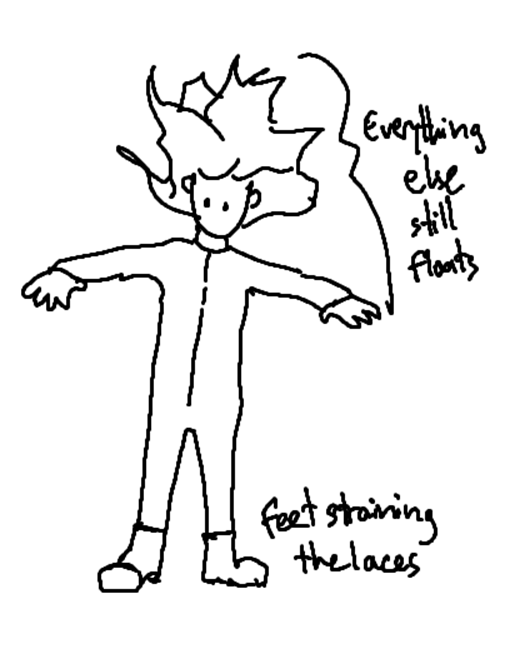
Ah, right. The OTHER allure of magnets. I have read enough books where the main characters wear magnetic boots to allow them to walk around normally in their space craft. I think Arthur C Clark even had this in 2001 a Space Odessey. But at least Clark also admitted that everything else would still float while you strained against your Kevlar boot laces and accumulated the charlie horse from hell in your calves. Just because your feet stick to the ground doesn’t mean the rest of you is gonna suddenly want to also act like you need a couch to faint on. Unless you put magnets in your butt padding too. I dunno, you do you. I did read a few stories (granted, they were in development, and I provided feedback, it’s the journey, don’t worry about it) where the characters were explained away to have magnet boots, but then they proceeded to flop on a couch, or pull off some impressive dance moves and the whole time I’m thinking “isn’t the rest of them floating?”
Magnetics are super useful, can absolutely have a place. Star Trek: First Contact has Warf walking the outer hull of the Enterprise in mag boots. Excellent effect. Especially since he even comments on it making him sick to his stomach, and then his tools float away. A+ no notes. But if you break out magnets you gotta be ready for ALL of it. Its not just a sweep it under the rug kinda explanation. You are setting yourself up for a LOT of story telling. The same is said for sticky shoes (Dead Space had gecko shoes. Same point). If you are making your characters walk around via the strength of their shoe laces tethering them to the floor, you better be ready to include plenty of cardio workouts, and calf rubs (which can certainly add to the romance sub-plot, especially if you are into feet).
Okay, what is the next egregious pitfall? Pressure. And I feel so bad about picking on this one, so I’ll make us all feel better and tell you that high ranking engineer savvy people have incorrectly assumed that just because something is at 300 psi pressure that it is glued down tight. Because its not. Think about the people hanging out at the bottom of the ocean in those oil rigs or observation stations/ Bond villain lairs. Or watch James Cameron’s The Abyss. They are at high pressure, higher than what we feel here on earth. But they aren’t plastered to the wall with it. That’s because everything is at pressure too. Pressure only creates a force on something when there is a pressure difference. Like when there’s a cozy little space craft pressurized to keep the human beings riding in it from turning inside out, but the outside of the space craft is the chilling void of eternal deep space. If you accidentally bump the airlock and snap off the rivets all that internal pressure could blast that metal panel out into space with enough force to look like gravity. But it is only because there was a difference. When someone says “oh that bulkhead is held in place by pressure, it means there’s more pressure on one side than the side your soft fleshy body is standing on, so maybe don’t stand there?

Its hard to use this as a method to generate “gravity” on someone. You would need to press down on them with a massive balloon or something that was at a higher pressure than the area surrounding them. Just increasing the pressure around someone wont magically push them to the walls. We’re made of water. We’re incompressible.
Ah, okay, next recipe for gravity, Recall I mentioned acceleration? Yes, we can use that. Certainly. Maybe we don’t have the ability to create an earth-sized mass to simulate gravity, but we can accelerate ourselves fast enough to feel that force the gravity creates. We just need to be moving at 9.8 meters per second. I give the Shield Runner pirates a lot of credit here, the author knew this. She talked about it a lot in terms of whether the characters could afford to travel that fast (takes more fuel) and whether where they were going had “healthy grav”. Major points for really working it into the story and how its pitfalls can add to the dramatics (they were pirates on the run, they didn’t necessarily have the money for healthy anything). Point here being that using acceleration to mimic gravity requires the understanding that you now need to work in that acceleration. You need a LOT of fuel to accelerate at 9.8 m/s for the whole flight. Then you need to slow down at some point, so you need to turn around to get used to walking on the ceiling (points to Shield Runners again if you wanna see what I mean). What I’m saying is, its gonna be part of your story if you pick this route.
Trust me on this, its like 50% of Space Sation X. Linear acceleration is a tough tale to sell. But angular acceleration is actually not at all out of the realm of possibility in science. I’m sure there’s a half dozen “rotating space station” ideas out there moldering on some old NASA employee’s desk. We’re nerdy like that. But its true. You rotate something around a center point and you generate an outwards, centripetal force. You see it in The Martian, you see it in Stowaway (fantastic management of gravity, shitty film). Having a rotating structure in space can potentially generate gravity. You just need to remember then that everything is spinning. Hope no one gets motion sickness. Also, you could be like me and want a Station where there are concentric rings making different “floors” even though that means each floor will have a different level of “gravity” and yes I did calculate it out for my Space Station thank you very much. Its even got its own plot points. Honestly, I would have done better with a rolling tube in space, but then I couldn’t have so many fraught moments between pining lesbians hanging out in a stairwell, and you know, priorities win.
So what is the answer for all you out there thinking of dipping a toe into space travel fiction? Honestly, its best if you just don’t even say it. Do the Star Wars thing. Don’t even address the fact that every planet has exactly the same gravity (don’t you DARE try to fuck with this Disney you rat bastards). Or, if you really want to wade into this deep end, know that it will need to be part of your story, and try to avoid the pitfalls that just make your lonely few sciencey readers go “wait, huh?” Everyone else is probably still gonna have a good time though.
For anyone who has stuck around this far, my first book, Space Station X, comes out on audiobook today. Feel free to check it out if you want more stories with questionable use of gravity, even by a certified rocket scientist.
https://rbmediaglobal.com/audiobook/9798331920562/
 AZ ROZKILLIS